Vestwell Savings Report: Why High-Earning Employees Feel Just as Lost About Money as Everyone Else

There's a common assumption that financial stress ebbs as income rises. However, recent Vestwell research tells a different story.
Our 2026 Saver Survey of 1,000+ working Americans revealed that confidence about money has very little to do with how much you make. We've broken down two of the report's key findings: why confidence gaps persist regardless of income, and where employees turn for help instead of their employer.
Confidence Is Thin Across Ages and Income Levels
Why is financial confidence so low in the first place? According to the Federal Reserve Bank of New York, total household debt is on pace to cross $19 trillion, with credit card and auto loan delinquencies at some of the highest levels the bank has ever recorded. The cost of living has climbed roughly 38% over the last ten years, and 53% of Americans now carry a credit card balance specifically to cover essential living expenses like groceries and rent.
Mortgage rates have hovered above 6.4% for much of 2026, with even small rate increases adding hundreds of dollars to a typical monthly payment. Buying a home, financing a car, or carrying a balance on credit cards all cost more than they used to. And, that's happening all at the same time that everyday expenses are eating a bigger share of every paycheck.
It's a cycle that's hard for workers to feel confident in: prices rise, credit fills the gap, and the interest on that credit makes the next paycheck stretch even further. It's no surprise that employees feel a lack of confidence, no matter their age or income level.
The Confidence Gap Doesn't Close With Age
Workers in their 20s report the lowest confidence, at 29%, which isn't surprising given how early they are in their financial lives. But that uncertainty doesn't disappear with age: 26% of workers in their 50s, many of them within a decade or two of retirement, report the same low confidence.
Confidence Isn’t Scaling With Income
Among survey respondents earning $200,000 or more, 64% described themselves as only "somewhat confident" in where their next paycheck dollar should go. Among workers earning under $75,000, 29% said they're not very confident or don't know where to start at all.
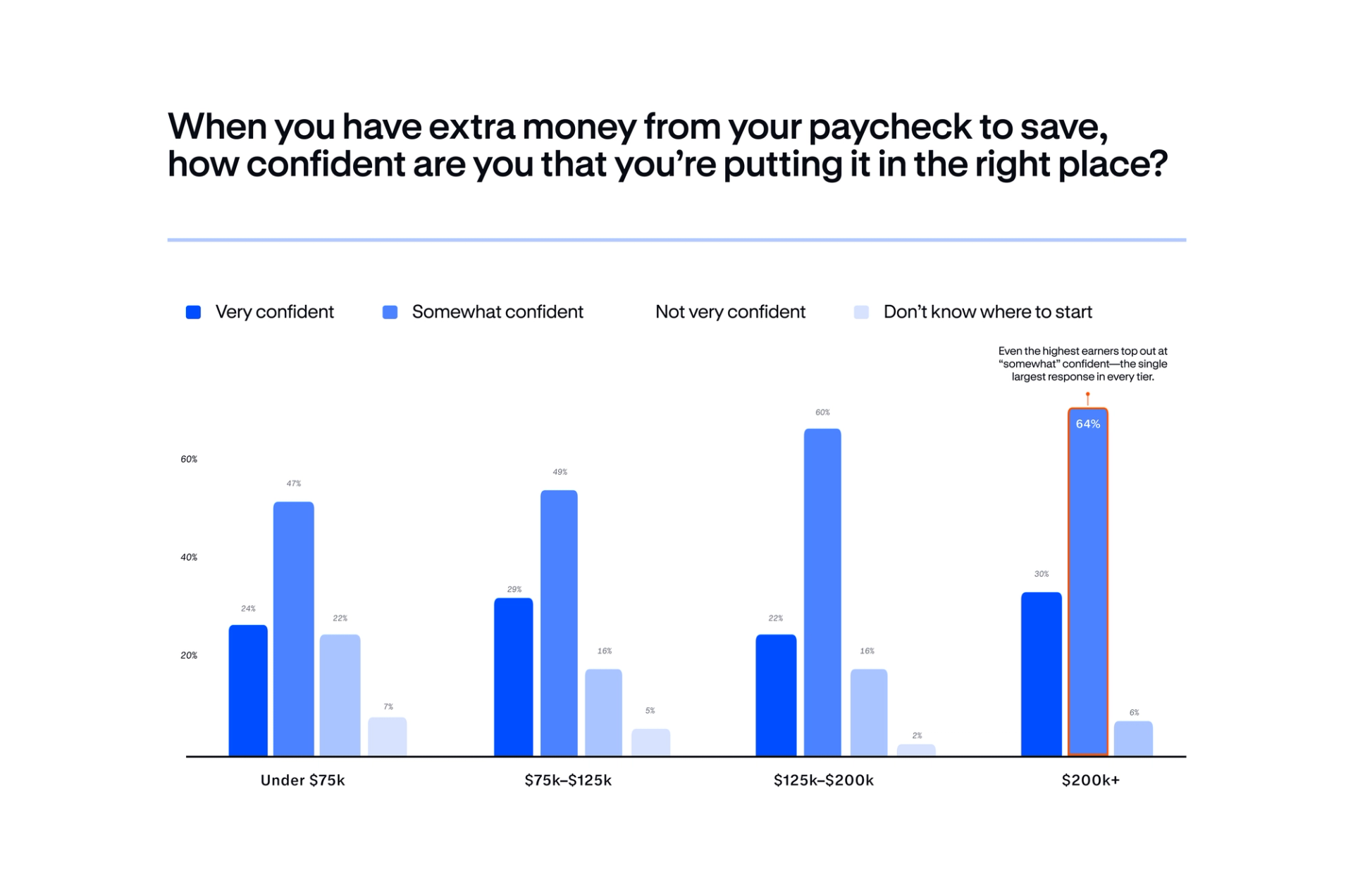
The nature of the pressure shifts with income, where for lower earners, the competing obligations reported were rent, credit card debt, and student loans, and for higher earners, it was mortgage, childcare, or supporting family members financially. But the underlying uncertainty shows up at every income level.
The takeaway for employers? A one-size-fits-all approach to financial wellness leaves people behind at every income level and every life stage. The employee earning $220,000 may need just as much help deciding what to do next as the employee earning $60,000, and the 25-year-old just starting out may need just as much support as the 55-year-old approaching retirement.
Workers Are Looking Elsewhere for Guidance
If employees aren't confident and aren't finding answers at work, where are they turning instead? Forty-four percent of respondents said they turn to friends or family for financial guidance, 36% use online search or social media, and 31% use a financial advisor. 18% said they use AI tools like ChatGPT, the same share that use budgeting apps, and more than the 12% who turn to their employer's benefits or HR platform.
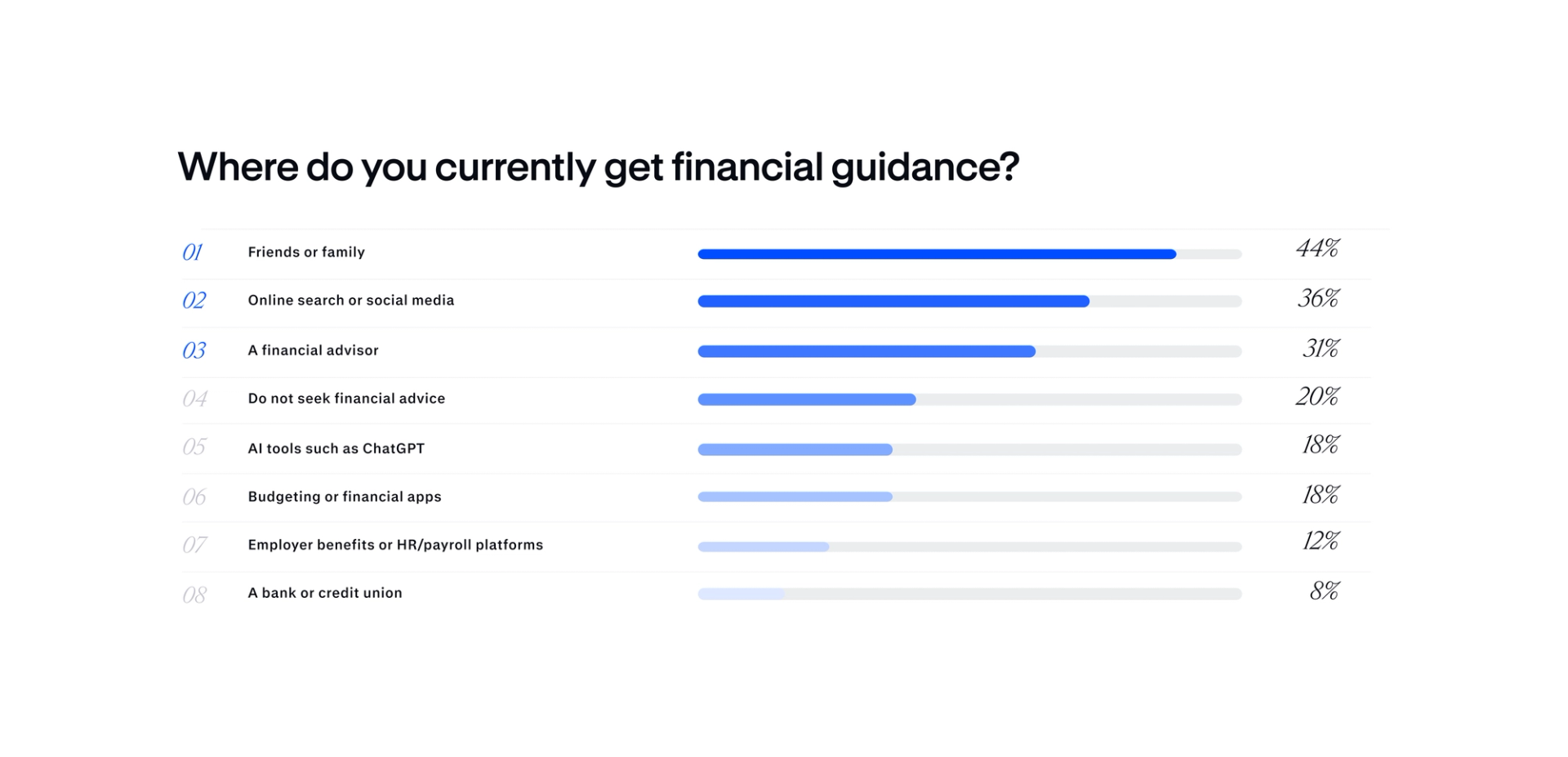
Employers already have a direct relationship with employees and their paychecks, and are still one of the least-used sources of financial guidance. Friends and family, a Google search, and an AI chatbot are all more trusted right now than their HR department, which is already actively providing financial benefits.
The guidance employees seek out also shifts sharply by generation:
- Among workers in their 20s, 63% rely on friends or family, and only 14% use a financial advisor.
- Among workers in their 60s, 53% use a financial advisor, and just 15% turn to social media or search.
Household structure matters too, where single respondents without dependents lean most on informal sources, while the use of a financial advisor nearly doubles among married couples with dependents.
But across every group, employer channels are barely used. That creates an opportunity for employers to become a more trusted source of financial guidance than the people, apps, and AI tools employees currently rely on instead.
A 401(k) Alone Isn't Solving For This
It's tempting to assume that a strong retirement plan makes employees trust their employer more and feel more confident about financial decision-making, but it doesn't. And though the survey found that 90% of workers now consider a 401(k) essential or very important to their employment, that expectation has become table stakes rather than a source of guidance. Sixty-one percent describe it as a baseline benefit they simply expect, not something that helps them figure out what to do with the rest of their paycheck.
In other words, offering a 401(k) answers the question of whether an employer takes employee well-being seriously. However, it doesn't answer the question employees are actually stuck on: given everything else competing for their paycheck, what should they prioritize, where exactly should they put their dollars, and in what order?
The Opportunity Employers Are Missing
Here’s the bottom line: confidence is low at every age and income level, and employees are getting the most help from sources that have no visibility into their actual benefits, paycheck, or complete financial picture.
This picture paints a real opportunity for employers. The workforce already trusts its employer enough to expect a 401(k). Extending that trust into real financial guidance is a way to reach the employees currently piecing together financial decisions from friends, search results, and chatbots.
Ready to give your employees a retirement plan, and beyond? Launch a comprehensive savings package with Vestwell today.